In the 1970s, a grave was looted in the village of Niño Korin in Bolivia. The artefacts were purchased and smuggled into Sweden on behalf of the then director of the Ethnographic Museum in Gothenburg. The grave belonged to a kallawaya, a traditional healer in Andean culture. Among the artefacts is a small bag, whose checkered pattern mirrors that of the wiphala.
A wiphala is a multicoloured square flag used by several Andean cultures, symbolising identity, community and resilience. The wiphala is a powerful symbol in the struggle for the rights of indigenous cultures in Bolivia and other parts of the Andes. But there are also tensions and conflicts surrounding it.
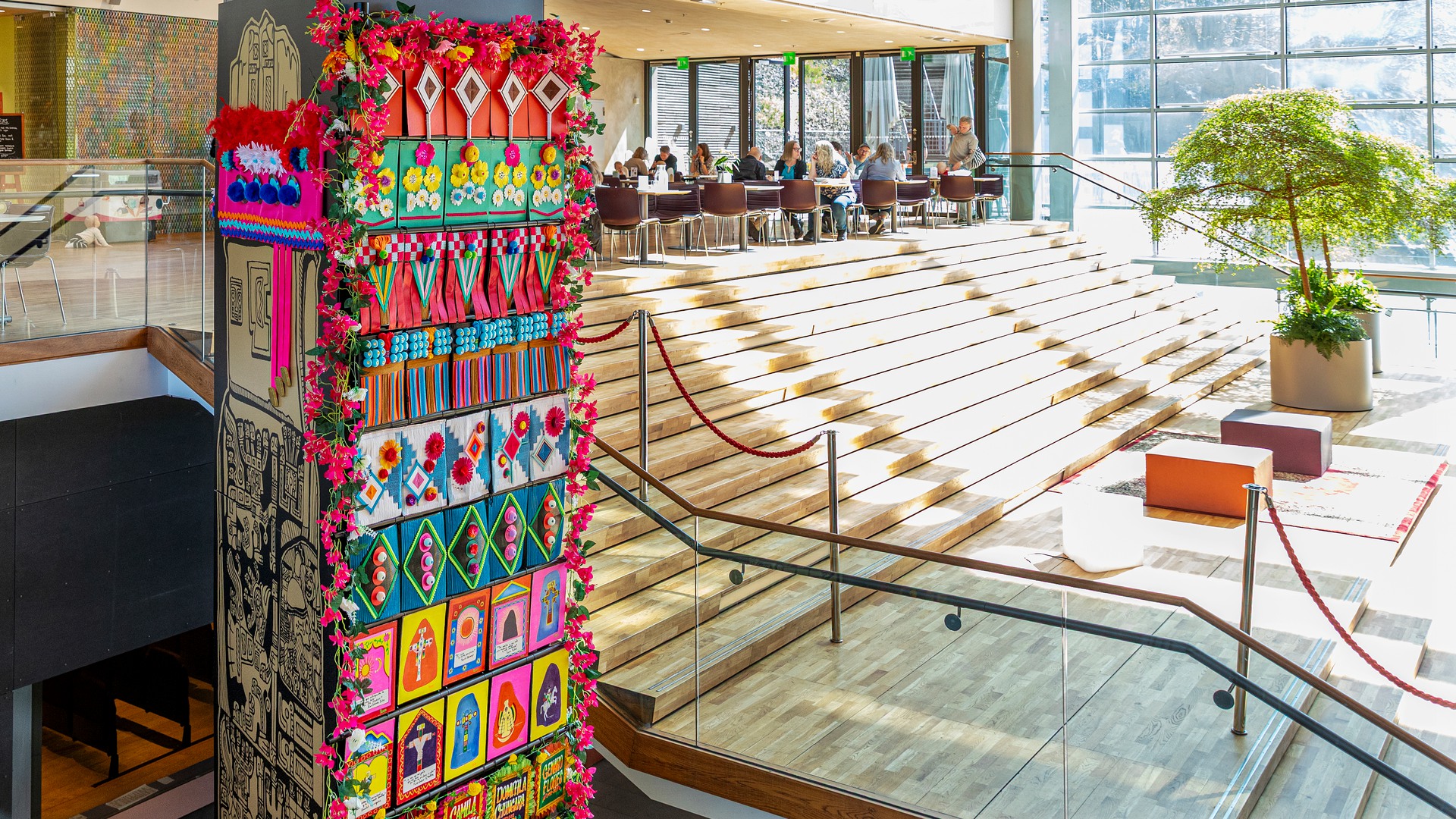
The Museum of World Culture is now presenting a new installation in the museum’s entrance hall, created as an artistic and historical reflection on the objects’ journey from Niño Korin in Bolivia to Sweden – and now the path towards repatriation. The installation takes its cue from the small bag featuring the wiphala pattern.
“Our responsibility is not just to display objects, but also to explain how they came to be here and what their presence in the collections signifies,” says exhibition producer Johan Rödström.
The installation at the Museum of World Culture includes the work Wiphala • Pukara • Wanka, an artistic installation created by Mirna and Erica Ticona. They have their roots in Bolivia and are based in Sweden. The work is built around an eight-metre-high pillar. One side depicts a Gran Pukara, a sacrificial sculpture based on an annual Andean ritual in which offerings are made to Pachamama (Mother Earth). The other three sides depict Pachamama and some of the objects currently held in the museum’s collections, including the small Wiphala.
The Museum of World Culture highlights the story behind these objects and how they have been interpreted and re-evaluated. Together, they form an installation that highlights indigenous peoples’ rights, the responsibilities of museums, and the ongoing process of returning the objects to Bolivia.
The installation Wiphalan from Niño Korin is part of the project Bringing Objects to Life – and Challenging Museums’ Colonial Histories, which is partly funded by the Riksbankens Jubileumsfond.